New Lettering: The Ultimate Script for Creative Expression and Professional Typography
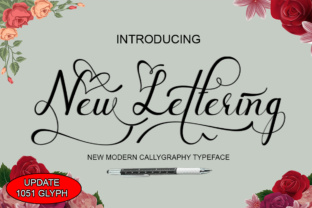
In the world of design and digital communication, finding a typeface that combines artistic flair with effortless utility is a constant pursuit. New Lettering emerges as a definitive answer to this quest. It is not merely a font; it is a comprehensive script system, a toolkit for typographic expression featuring over 1050 unique glyphs. For designers, marketers, crafters, and anyone looking to elevate their visual projects, understanding and utilizing New Lettering can transform your approach to text.
Understanding the Power of New Lettering
At its core, New Lettering is a stunning script typeface designed for maximum versatility and ease of use. The term "script" here refers to fonts that mimic handwriting, offering fluid, connected, and often elegant letterforms. What sets New Lettering apart is its staggering breadth. With more than 1050 distinct glyphs—which include letters, numbers, symbols, ligatures, and alternates—it provides an almost limitless palette for customization. Furthermore, its complete PUA (Private Use Area) encoding is the technical key that makes this vast library practically accessible. PUA encoding assigns these special characters to specific, unused code points in the Unicode standard, allowing them to function seamlessly in virtually any software application, from professional Adobe suites to simple word processors or social media tools.
Common Challenges in Typography and Design
Many creatives face specific hurdles when seeking the perfect typographic voice for their projects. You might struggle with a script font that looks beautiful but lacks the alternative characters needed to avoid a repetitive, cookie-cutter look. Perhaps you’ve found a font with great extras, but it’s cumbersome to access those special swashes or ligatures outside of one particular design program. There’s also the common goal of maintaining brand consistency across diverse mediums—from a website banner to a printed invitation—while still injecting creative uniqueness. For small business owners or content creators, the need is often pragmatic: a single, reliable, and gorgeous font that works everywhere without technical headaches.
How New Lettering Addresses These Needs
New Lettering directly solves these problems by merging exhaustive creative resources with universal compatibility. The 1050+ glyphs mean you can craft words that are truly unique. Instead of every "A" looking identical, you can choose from multiple stylistic alternates, connect letters with elegant ligatures, or add decorative beginning and ending swashes. This solves the issue of visual monotony. The PUA encoding is the unsung hero here. Because the font is built this way, you can access this full glyph set in any application that supports font selection. Whether you’re designing in Photoshop, writing in Microsoft Word, or creating a quote graphic in Canva, the entire character set is available, typically through a glyph panel or character map utility. This removes the barrier between inspiration and execution.
Practical Applications and Transformative Outcomes
The real-world uses for New Lettering are vast. Consider a wedding stationery designer. They can use the font to create cohesive, custom-looking invitations, place cards, and programs, with each client’s names rendered in a slightly different, personalized style using the alternates. A digital marketer can employ New Lettering to produce standout social media graphics, email headers, and promotional materials that feel hand-crafted and personal, enhancing brand connection. For a crafter creating personalized gifts, the font enables the easy generation of intricate, script-style text for engraving, vinyl cutting, or embroidery patterns.
The outcome is consistently elevated aesthetics. Projects gain a perceived value and artistry. They communicate care, attention to detail, and a bespoke quality that standard fonts often cannot. Furthermore, because the font works everywhere, it streamlines the workflow, saving time and frustration. You invest in one robust tool instead of juggling multiple, situation-specific fonts.
Recommendations for Different Users
The way you approach New Lettering will depend on your expertise and goals.
- For Professional Designers: Dive deep into the glyph set. Use the alternates and ligatures to establish rhythmic patterns in your typography. Experiment with combining glyphs to create entirely new logotypes or decorative elements. Consider New Lettering as a base for custom lettering projects where you need a starting point of incredible variety.
- For Business Owners and Content Creators: Start by using the font for key visual elements like logos, headline text, and quotes. Familiarize yourself with how to access the glyph panel in your most-used software. Even using a few basic alternates can make your materials look more professional and distinct. The font’s ease of use means you don’t need advanced technical knowledge to benefit from its richness.
- For Crafters and DIY Enthusiasts: Focus on the font’s compatibility with your design software, whether it’s for a cutting machine or print-on-demand service. Use the clear, elegant letterforms for names, dates, and short messages on your projects. The variety helps ensure that even common words can be rendered in a unique way for each item you make.
Implementing New Lettering Effectively
To get the most from New Lettering, a few considerations are useful. First, upon installing the font, take time to explore its character map. This will give you a visual catalog of all available glyphs. Second, remember that while it is a script, its vast options allow for both formal, connected writing and more casual, disconnected looks by choosing appropriate characters. Third, for long body text, it’s advisable to use a simpler complementary font; New Lettering is best deployed for headlines, accents, and short blocks where its artistry can shine without overwhelming readability.
Ultimately, New Lettering represents a shift from seeing fonts as fixed tools to viewing them as flexible partners in creativity. Its combination of massive glyph variety and PUA-encoded universality respects both the designer’s need for expression and the practical user’s need for simplicity. By focusing on the outcomes—more unique designs, smoother workflows, and consistently higher-quality visuals—you can leverage New Lettering not just as a script, but as a solution for a wide array of typographic challenges.
In your next project, whether it’s a brand launch, a personal gift, or a social media campaign, consider beginning with New Lettering. Its over 1050 glyphs await to transform your words from simple text into compelling visual statements, all while ensuring the process is as straightforward as typing in your favorite word processor. That is the true power and promise of this remarkable script system.