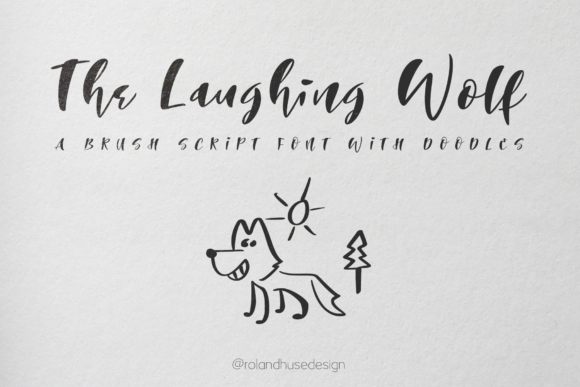
The Laughing Wolf Font: A Playful Tool for Process-Driven Creativity
Within the ecosystem of digital tools, fonts often occupy a functional, utilitarian space. Their primary job is to convey information clearly. However, a unique typeface can transcend this role, becoming an active participant in the creative workflow itself. The Laughing Wolf is precisely such a font. Created for Ipas, this brush script moves beyond mere aesthetics. Its carefully designed clean vectors and, most notably, its integrated set of seven wolf doodle characters offer a tangible asset for anyone looking to inject a signature style of playfulness and identity into their process. It’s a resource that integrates directly into the execution phase, influencing both the form and the feel of a project’s final output.
Where The Laughing Wolf Fits in Your Creative Process
Understanding where a tool belongs in your workflow is crucial for effective implementation. The Laughing Wolf is not typically a tool for the initial ideation or planning stages—those are dominated by notes, sketches, and rough drafts. Instead, its natural home is in the execution and refinement phases. When your concepts are solidified and you move into production—whether for a digital publication, a marketing asset, a personal project, or educational material—this font becomes available as a stylistic choice. It acts as a final layer of character, applied to titles, callouts, bullet points, and decorative text elements to elevate the work from standard to distinctive.
Consider a common workflow for a content creator or marketer: research, outline, draft, design, publish. The Laughing Wolf enters the scene during the design step. After the copy is written in a standard body font, you might apply The Laughing Wolf to the main headline to grab attention with its friendly, hand-crafted feel. Then, within the body text, you could employ its unique doodles via the Stylistic Set’s Bulletpoint Alt Option 8 to replace generic bullet characters. This integration happens seamlessly within your design software (like Adobe Illustrator, InDesign, or even Canva), affecting the visual outcome without altering the core content creation process that preceded it.
Interacting with Other Tools and Assets
A tool’s value is often determined by its compatibility. The Laughing Wolf, as a clean vector-based OpenType font, interacts smoothly with standard design platforms. It doesn’t require special plug-ins or complex procedures. Its integration is as straightforward as selecting it from your font menu. This ease of use is critical for maintaining efficiency. For professionals juggling multiple projects, a font that works without fuss supports consistency across outputs—you can establish a brand guideline that specifies “use The Laughing Wolf for H1 headers and bullet points,” and your team can implement it reliably.
Furthermore, it interacts with your existing asset library. Perhaps you have a set of brand illustrations or a particular color palette. The playful, organic lines of The Laughing Wolf’s script and doodles can complement illustrative assets, creating a cohesive visual language. For a small business owner creating social media graphics, pairing this font with simple vector icons can result in a suite of materials that feel custom-designed and approachable, without requiring extensive graphic design expertise.
Practical Implementation and Workflow Examples
Let’s move from theory to practice. How do you actually use The Laughing Wolf in a real-world scenario? The key feature is the set of seven wolf doodles accessible through the font’s Stylistic Sets. Instead of manually inserting an image for a bullet point, you can simply apply the alternate character set. This is a significant efficiency gain: it ensures consistency (every bullet is stylistically identical), reduces file complexity (no extra embedded images), and speeds up the workflow.
Example for an Educator or Course Creator: You’re designing a PDF worksheet or an online learning module. After writing the lesson content, you format the key takeaways or a step-by-step activity list. By setting your bulleted list to use The Laughing Wolf with the Bulletpoint Alt Option 8 activated, each point begins with a charming wolf icon. This subtle touch makes the material more engaging and visually memorable for students, enhancing the quality of the educational asset without distracting from the core information.
Example for a Blogger or Freelancer: You want your blog posts or client reports to stand out. Beyond a great headline using the main script, you can use the wolf doodles within sidebars, callout boxes, or lists of resources. This creates a signature visual motif that readers begin to associate with your work, aiding in long-term brand recognition. The implementation is a simple font selection during the CSS styling or document formatting stage.
Tips for Smooth Integration and Quality Control
To integrate The Laughing Wolf smoothly, a little preparation helps. First, ensure it is properly installed on your system and available to all relevant software. Second, familiarize yourself with how to access the Stylistic Sets in your primary application—this might involve a glyph panel or OpenType features menu. Document this process for yourself or your team to prevent future friction.
Usability is excellent due to its clean vectors; it scales well for both print and digital use without losing detail. However, remember its stylistic purpose: it’s best used for emphasis and decoration, not for long body text paragraphs. Overuse can undermine readability. A practical rule is to employ it for elements where you want to convey personality, playfulness, or a hand-made aesthetic.
For organization and consistency, you might create a small style guide snippet for your projects: “H1: The Laughing Wolf, 32pt. Bulleted Lists: The Laughing Wolf with Stylistic Set ‘Bulletpoint Alt Option 8’ active.” This formalizes its role and ensures that every time you or a collaborator produces a document, poster, or web graphic, the unique character of The Laughing Wolf is applied uniformly, elevating the overall quality control of your outputs.
Long-Term Use and Outcome Considerations
Adopting a distinctive font like The Laughing Wolf is a decision with long-term implications. Its consistent use across a series of projects—a blog, a product line, a course series—builds a cohesive visual identity. This is particularly valuable for entrepreneurs, hobbyists building a public presence, and publishers looking to differentiate their materials. The wolf doodles become a recognizable graphic element, almost like a secondary logo.
The outcome is not merely a “pretty document.” It’s about creating a finished product that feels thoughtfully crafted and engaging. In a landscape saturated with generic templates, this extra layer of custom styling can impact perception. A client receiving a proposal with these playful touches might subconsciously associate the work with creativity and attention to detail. An audience viewing a social media post with a headline rendered in The Laughing Wolf might find it more approachable and clickable.
Ultimately, The Laughing Wolf is a practical asset for those who understand that the final presentation of their work is a critical part of the process. It fits neatly into the execution phase, interacting effortlessly with standard tools, and provides a simple yet effective method to elevate the character of your outputs. By planning its role, mastering its unique features like the alternative bullet doodles, and applying it with strategic restraint, you can integrate this brush script into your workflow to consistently produce work that is not only clear and professional but also distinctively engaging.